

Hey there! As a supplier of Air Tire Inflator, I often get asked this question: "How long does it take to inflate a tire with an air tire inflator?" Well, it's not a one - size - fits - all answer, and in this blog, I'll break down the factors that influence the inflation time and give you a better idea of what to expect.
Factors Affecting Tire Inflation Time
Tire Size
First off, the size of the tire plays a huge role. Smaller tires, like those on bicycles or motorcycles, have a much lower volume compared to car tires or truck tires. For example, a typical bicycle tire might have a volume of around 1 - 2 liters, while a car tire can hold anywhere from 40 - 60 liters of air.
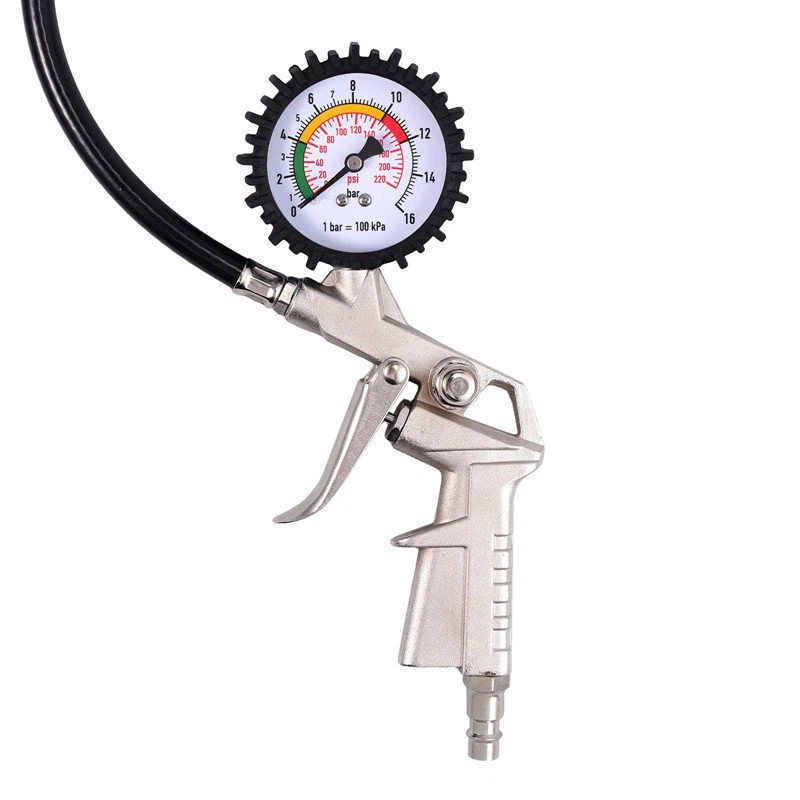
Let's say you're using a standard air tire inflator with a flow rate of 30 liters per minute. Inflating a small bicycle tire from flat to the recommended pressure (usually around 80 - 100 psi) might take less than a minute. On the other hand, a large car tire that needs to go from 20 psi to the recommended 32 psi could take 3 - 5 minutes. And if you're dealing with big truck tires, which can have volumes over 100 liters, the inflation time can easily go up to 10 minutes or more.
Initial Tire Pressure
The starting pressure of the tire also matters. If a tire is completely flat, it will take longer to inflate compared to a tire that only needs a small top - up. For instance, if a car tire is at 25 psi and the recommended pressure is 32 psi, it will take less time to reach the target pressure than if the tire was at 10 psi.
Think of it like filling a glass with water. If the glass is already half - full, it'll take less time to fill it to the brim than if it's completely empty. So, always check your tire pressure regularly and top up when needed to save time on inflation.
Air Tire Inflator Capacity
Not all air tire inflators are created equal. The capacity, or the flow rate, of the inflator is a key factor. A high - capacity inflator can pump more air into the tire in a shorter amount of time.
There are inflators with flow rates as low as 15 liters per minute and others that can go up to 60 liters per minute or even higher. If you have a high - capacity inflator, you can cut down the inflation time significantly. For example, an inflator with a 60 - liter - per - minute flow rate can inflate a car tire in half the time it would take a 30 - liter - per - minute inflator.
Tire Pressure Requirement
Different vehicles have different recommended tire pressures. Bicycle tires usually require higher pressures (around 80 - 130 psi), while car tires typically need around 30 - 35 psi, and truck tires can range from 50 - 80 psi.
The higher the target pressure, the longer it will take to inflate the tire. This is because as the pressure inside the tire increases, it becomes more difficult for the inflator to push more air in. It's like trying to blow up a balloon; it gets harder and harder as the balloon fills up.

Calculating Inflation Time
While it's hard to give an exact inflation time without knowing all the details, we can use a simple formula to get a rough estimate. The formula is:
[
\text{Inflation Time}=\frac{\text{Volume of Air Needed}}{\text{Flow Rate of the Inflator}}
]
Let's take an example. Suppose you have a car tire with a volume of 50 liters, and it's currently at 20 psi. The recommended pressure is 32 psi. You can calculate the volume of air needed to reach the target pressure using the ideal gas law (although in a more practical sense, you can use some pre - calculated tables). Let's assume you need to add 15 liters of air to reach the right pressure.
If you're using an inflator with a flow rate of 30 liters per minute, then:
[
\text{Inflation Time}=\frac{15}{30}=0.5\text{ minutes or }30\text{ seconds}
]
Keep in mind that this is a simplified calculation. In real - world scenarios, there are other factors like the efficiency of the inflator, any air leaks, and the resistance of the tire valve that can affect the actual inflation time.
Tips to Reduce Inflation Time
Maintain Your Inflator
Regularly cleaning and servicing your air tire inflator can ensure it operates at its peak efficiency. A well - maintained inflator will have a consistent flow rate and will be able to pump air into the tire more quickly. Check the filters, hoses, and connections for any signs of wear or blockage.
Use the Right Nozzle
Make sure you're using the correct nozzle for your tire. A proper fit will reduce air leakage and allow the inflator to work more effectively. Some inflators come with multiple nozzles for different types of tires, so choose the one that's right for your vehicle.
Check for Leaks
Before you start inflating the tire, check for any air leaks. A leaking tire will take longer to inflate because the air you're pumping in is constantly escaping. You can use a soapy water solution to check for leaks; if you see bubbles forming, there's a leak that needs to be fixed.
Why Choose Our Air Tire Inflators
As a supplier of Air Tire Inflator, we take pride in offering high - quality products. Our inflators are designed with the latest technology to ensure a fast and efficient inflation process.
We have a wide range of inflators with different flow rates to suit your needs. Whether you're a casual cyclist, a car owner, or a truck driver, we have an inflator that's right for you. Our inflators are also built to last, with durable materials and reliable components.
If you're tired of waiting around for your tires to inflate or if you're looking for a more reliable inflator, we're here to help. Our team is always ready to answer your questions and provide you with the best solution for your tire inflation needs.
Conclusion
So, how long does it take to inflate a tire with an air tire inflator? It depends on several factors, including tire size, initial pressure, inflator capacity, and the target pressure. By understanding these factors and following some simple tips, you can reduce the inflation time and get back on the road faster.
If you're interested in purchasing one of our high - quality Air Tire Inflators, don't hesitate to get in touch. We're eager to discuss your requirements and help you find the perfect inflator for your needs. Whether you're a small - scale user or a large - scale business, we can offer you a great deal. Contact us today to start the procurement negotiation process!

References
- "Automotive Tire Technology" - A general automotive textbook that covers tire basics and inflation.
- Various online resources on tire maintenance and inflator technology.


