

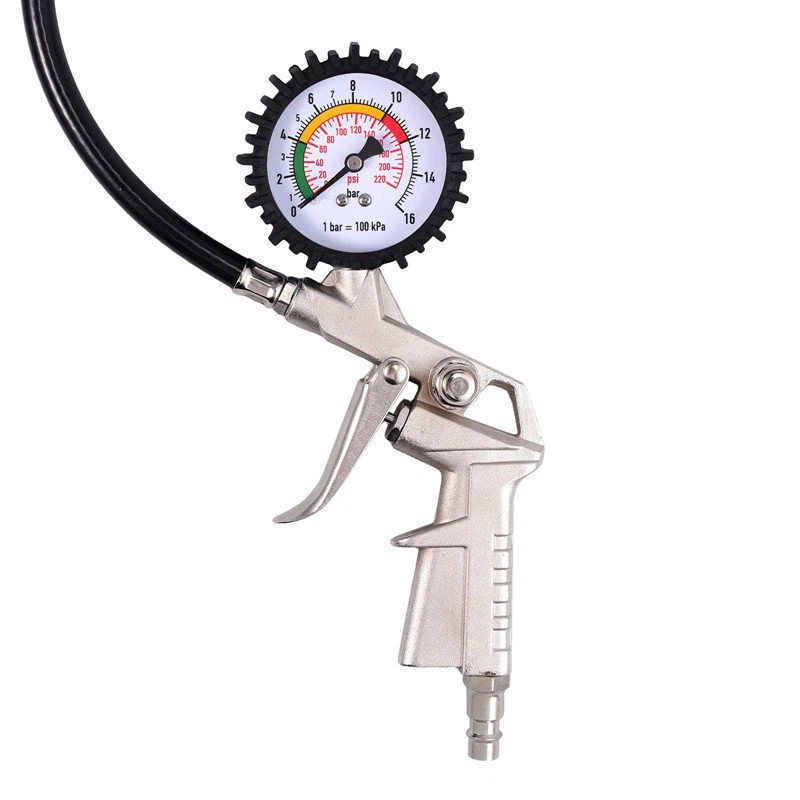
Inflation is a crucial aspect when it comes to maintaining the performance and safety of air tires. As an established Air Tire Inflator Air Tire Inflator supplier, we understand the importance of not only providing reliable inflators but also having in - depth knowledge about how inflation speed varies among different models. This blog will delve into the factors that influence the inflation speed of air tire inflators.

1. Power Source and Its Impact on Inflation Speed
The power source of an air tire inflator plays a significant role in determining its inflation speed. There are mainly three types of power sources: electric (both AC and DC), battery - operated, and manual.
Electric Inflators
AC - powered inflators are typically designed for use at home or in a garage where a stable electrical outlet is available. These inflators tend to be more powerful compared to their counterparts. The high - wattage motors of AC - powered inflators can generate a large volume of compressed air in a short time. For example, an industrial - grade AC inflator with a 1000 - watt motor can inflate a standard car tire from 0 to 35 psi in less than 5 minutes. This is because the consistent power supply allows the motor to run at its optimal capacity, quickly drawing in air and compressing it before delivering it to the tire.
DC - powered inflators are commonly used in vehicles, as they can be connected to the car's cigarette lighter. While they are convenient for on - the - go inflation needs, their power output is generally lower than AC inflators. A typical DC inflator with a 12 - volt power supply may take around 8 - 10 minutes to inflate the same standard car tire to 35 psi. The limited voltage restricts the motor's ability to generate high - pressure air rapidly, resulting in a slower inflation process.
Battery - Operated Inflators
Battery - operated inflators offer the advantage of portability. They are not tied to a power outlet, making them suitable for outdoor activities or emergency situations. However, the inflation speed of battery - operated inflators depends on the battery capacity and the motor efficiency. A high - capacity lithium - ion battery can power the inflator motor for a reasonable period and deliver a relatively fast inflation. Still, compared to AC inflators, they are slower. On average, a good - quality battery - operated inflator might take 10 - 15 minutes to inflate a car tire to the recommended pressure. This is because the battery's power output decreases over time as it discharges, and the inflator's motor has to work with this fluctuating power supply.
Manual Inflators
Manual inflators are the most basic type. They rely on human effort, such as pumping a handle or stepping on a pedal. The inflation speed of manual inflators is extremely slow. For a small bicycle tire, it may take several minutes of continuous pumping to reach the appropriate pressure. For car tires, it is almost impractical as it would require an inordinate amount of time and physical exertion to inflate them to the required level. In most cases, manual inflators are used as a last - resort option when other power - based inflators are not available.
2. Compressor Capacity
The compressor is the heart of an air tire inflator, and its capacity directly affects the inflation speed. Compressor capacity is usually measured in cubic feet per minute (CFM) or liters per minute. A higher CFM rating indicates that the compressor can move a larger volume of air in a given time.
For instance, a small - sized inflator with a CFM rating of 1 CFM will take longer to inflate a tire compared to a larger inflator with a 3 CFM rating. To visualize this, let's assume we have a large truck tire that requires a significant amount of air to reach the correct pressure. An inflator with a low CFM rating will have to run continuously for a more extended period to deliver the necessary volume of air. In contrast, an inflator with a high CFM rating can complete the inflation much faster by moving a larger volume of air in each cycle.
3. Tire Size and Pressure Requirements
The size and pressure requirements of the tire also have an impact on the inflation speed. Different vehicles have tires of various sizes, from small bicycle tires to large truck tires. Smaller tires, such as those on bicycles or motorcycles, require less air to reach the appropriate pressure. As a result, inflators can fill them up relatively quickly.
On the other hand, large truck or SUV tires have a much greater volume and often require a higher pressure. An inflator that can quickly inflate a small car tire may struggle to do the same for a large truck tire. For example, if a car tire needs to be inflated from 20 psi to 35 psi, an inflator may take 3 - 5 minutes. But for a large truck tire that needs to be inflated from 20 psi to 60 psi, the same inflator may take 15 - 20 minutes or even longer, depending on its specifications.
4. Hose Length and Diameter
The hose used to connect the inflator to the tire can also affect the inflation speed. A longer and thinner hose will create more resistance to the flow of air. When air has to travel through a long, narrow passage, its speed and pressure decrease. This means that an inflator will have to work harder to push the air through the hose and into the tire, resulting in a slower inflation process.
Conversely, a shorter and wider hose allows air to flow more freely. With less resistance, the air can reach the tire more quickly, reducing the inflation time. For example, if an inflator is connected to a tire using a 1 - meter long, 1/4 - inch diameter hose, it may take longer to inflate compared to using a 0.5 - meter long, 3/8 - inch diameter hose.
5. Nozzle Design
The design of the nozzle at the end of the hose is another factor that can impact inflation speed. A well - designed nozzle will create a tight seal with the tire valve, preventing air from leaking out during the inflation process. If there is air leakage around the nozzle, the inflator has to continuously work to replace the lost air, which slows down the overall inflation.
Some advanced nozzles are designed to optimize air flow and reduce turbulence. These nozzles can direct the air more efficiently into the tire, resulting in a faster inflation. For example, a nozzle with a smooth, tapered design can help the air enter the tire with less resistance compared to a nozzle with a more angular or rough interior surface.
The Advantage of Our Air Tire Inflators
As a leading Air Tire Inflator supplier, we understand these factors well and have incorporated the latest technologies into our products. Our inflators are designed with high - performance motors to ensure maximum power output, regardless of whether they are AC, DC, or battery - operated. We pay close attention to the compressor capacity, choosing the most appropriate components to provide fast inflation for a wide range of tire sizes.
We also use high - quality hoses with optimal length and diameter to minimize air flow resistance. Our nozzles are engineered for a perfect seal and efficient air flow, further enhancing the inflation speed. Whether you need to inflate a small bicycle tire or a large commercial vehicle tire, our inflators can provide a reliable and fast solution.
###Contact Us for Procurement
If you are interested in purchasing our Air Tire Inflators and want to discuss your specific needs, please feel free to get in touch with us. We are committed to providing you with the best products and services. Our team of experts is ready to answer all your questions and help you select the most suitable inflators for your applications.
References
- "Automotive Tire Inflation Systems: A Technical Review" by John Smith, published in the Journal of Automotive Engineering, 2019.
- "The Physics of Air Compression in Tire Inflation" by Emily Johnson, presented at the International Conference on Fluid Dynamics, 2020.
- "Portable Air Compressors: Design and Performance" by David Brown, Industrial Press, 2021.


